Square Integration
The Square Integration app connects your Square POS account to J2Commerce and pulls your entire product catalog across in one step. Products, variations, inventory counts, pricing, categories, images, modifiers, and tax settings all flow from Square into J2Commerce automatically. Once the sync is running, you can sell on your Joomla site without maintaining a separate product list — Square stays the single source of truth for your inventory.
Sync direction in v1 is Square -> J2Commerce only. Edits made in J2Commerce do not push back to Square.
Requirements
- PHP 8.3.0 or later
- Joomla! 6.x
- J2Commerce 6.x
- A Square account (free or paid)
- An HTTPS-enabled Joomla site (required for OAuth and webhooks)
Purchase and Download
This app is a separate add-on available from the J2Commerce Extensions Store. It is not included with the core J2Commerce 6 component.
Step 1: Go to the J2Commerce website -> Apps
Step 2: Locate the Square Integration app -> click View Details -> Add to Cart -> Checkout
Step 3: Go to My Downloads under your profile button at the top right corner. Search for the app, click Available Versions -> View Files -> Download Now
Install the App
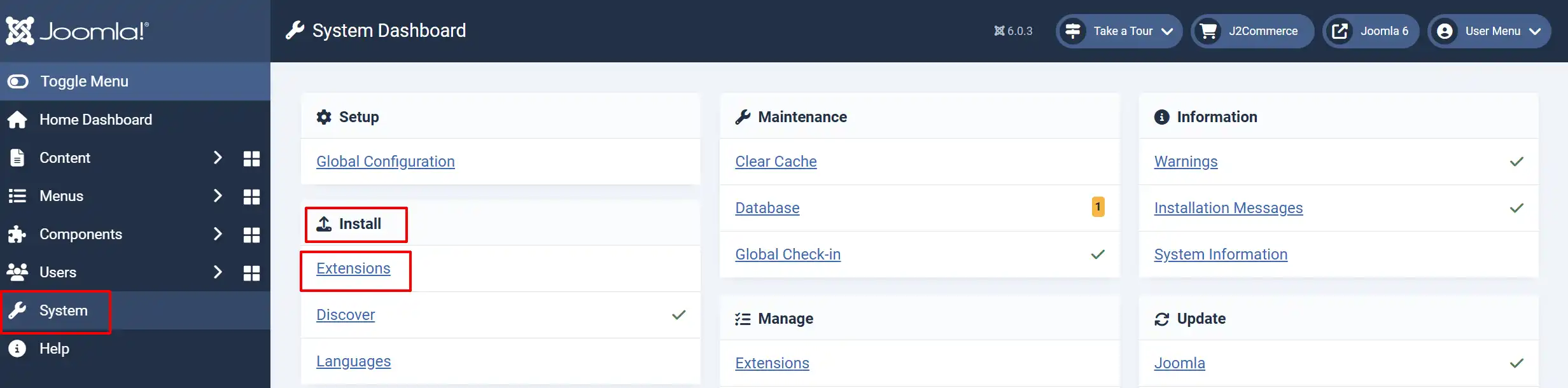
In the Joomla Administrator, go to System -> Install -> Extensions.
Upload the plugin ZIP file or use the Install from URL option.
Enable the App
Once installed, enable the app before configuring it. There are two ways to reach it.
Option A: Go to the J2Commerce icon at the top right corner -> Apps
Option B: Go to Components on the left sidebar -> J2Commerce -> Apps
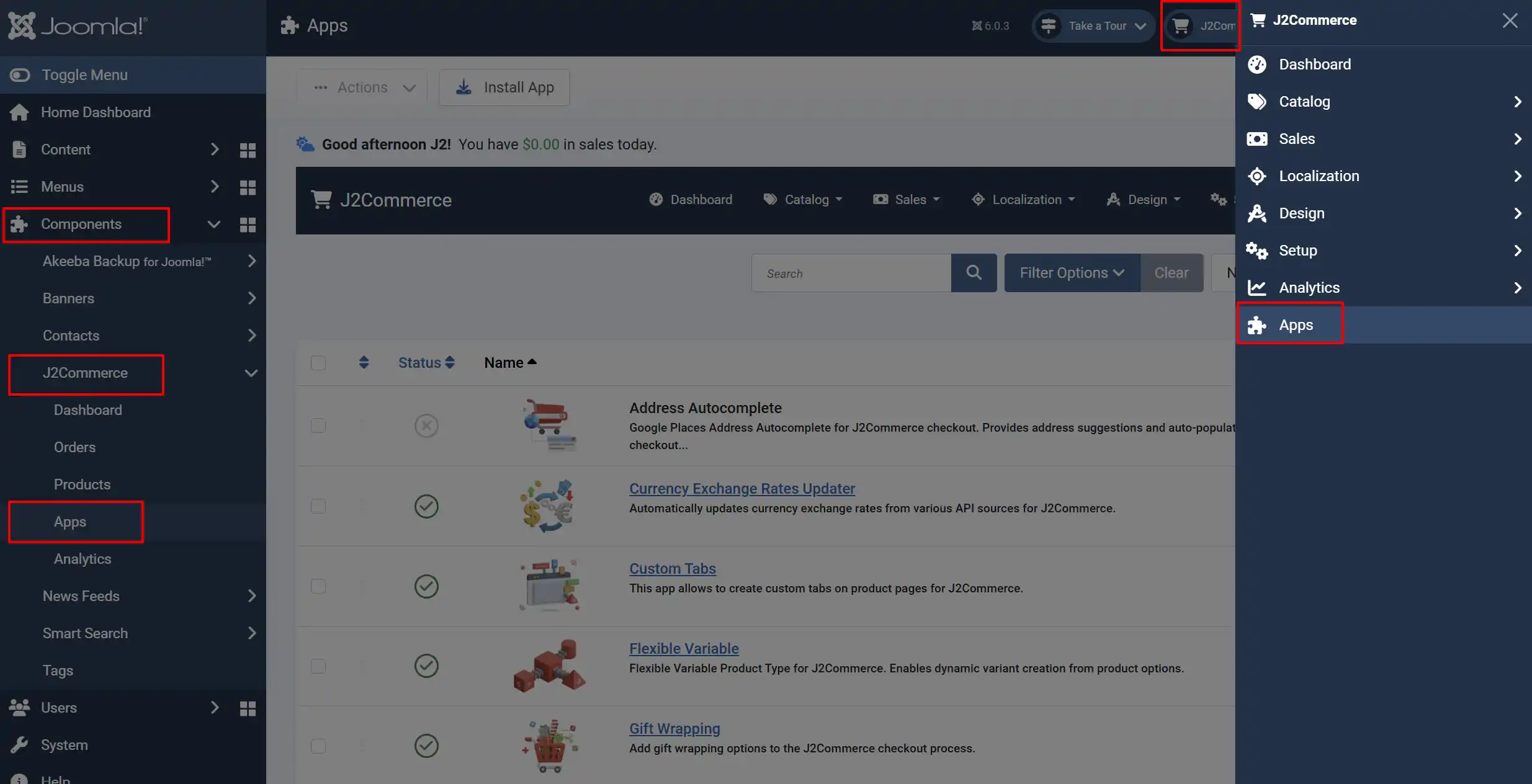
Find Square Integration in the list, click the status icon (it will turn from an X to a green checkmark). The app is now enabled and ready to configure.
Configure the App
Click the Square Integration title to open the configuration screen. The screen has seven tabs across the top: Dashboard, Connection, Locations, Products, Pricing, Sync, and Advanced.
Click the Toggle Inline Help button in the toolbar to display a description beneath each setting directly in the form.
Work through the tabs in the order below the first time you set up the integration.
First-Time Setup
Follow these steps in order to go from a fresh install to a working sync.
Step 1 — Create a Square Developer Application
- Go to developer.squareup.com/apps and sign in with your Square account.
- Click Create your first application (or + if you already have apps).
- Give it a name (for example, "My J2Commerce Store") and click Save.
- Open the app. In the left sidebar, click OAuth.
- Copy the Application ID and the Application Secret — you will paste these into J2Commerce in the next step.
Step 2 — Enter Credentials in J2Commerce
- Go to J2Commerce -> Apps -> Square Integration -> Connection tab.
- Set Environment to Sandbox (for testing) or Production (for live sales).
- Paste your Application ID and Application Secret from Square.
- Copy the Redirect URI shown in J2Commerce — you will need this in Step 3.
Step 3 — Register the Redirect URI in Square
- Return to the Square Developer Dashboard -> your app -> OAuth.
- In the Redirect URL field, paste the exact Redirect URI you copied from J2Commerce.
- Click Save. The URI must match character-for-character, including
https://, query string parameters liketmpl=component, and any trailing slash.
Step 4 — (Sandbox only) Open a Test Seller Session
If you are working in sandbox mode, Square requires an active test seller session in your browser before the OAuth consent page will render. See the Troubleshooting entry Connect to Square shows a blank page (sandbox) for full instructions.
Step 5 — Connect to Square
- Back in J2Commerce -> Connection tab, click Connect to Square.
- A popup opens. Square shows a consent screen — click Allow.
- The popup closes automatically and the status badge turns green showing Connected.
Step 6 — Select Locations
- Switch to the Locations tab.
- Click Refresh to load your Square locations.
- Select the locations you want to pull inventory from.
- Choose an Inventory Aggregation mode, then click Save.
Step 7 — Configure Product Defaults
- Switch to the Products tab.
- Set your defaults for import status, Joomla category, tags, tax profile, and other options.
- Click Save.
Step 8 — Run Your First Import
Open the Dashboard tab (or the Square Integration panel on the J2Commerce admin home) and click Import All to pull your full Square catalog into J2Commerce. Individual items can also be selected from the catalog browser.
Configuration Reference
Connection Tab
The Connection tab handles authentication with Square. Complete this tab before any other tab will function.
Environment: Choose Sandbox while testing or Production when live
Redirect URI: Read-only. Copy this exact URI into the Square Developer Dashboard OAuth -> Redirect URL field
Application ID: Your app's Application ID from the Square Developer Dashboard -> OAuth section
Application Secret: Your app's Application Secret from the Square Developer Dashboard -> OAuth section
Manual Access Token: Sandbox/dev fallback if OAuth is not yet configured. Enter a Square sandbox access token here instead of going through the popup flow
Connect to Square: Opens the Square OAuth popup. Authorizes J2Commerce to read your catalog
Test Connection: Verifies the saved credentials are valid and returns a pass or fail status
The recommended approach for both sandbox and production is OAuth — the Connect to Square button flow. The Manual Access Token option is provided for sandbox development only and does not support webhooks.
Locations Tab
Square businesses can have multiple physical or online locations. The Locations tab controls which ones feed inventory into J2Commerce.
Selected Locations: Multi-select list of your Square locations. Only checked locations contribute inventory to the sync
Inventory Aggregation: Sum — adds up stock counts across all selected locations. Primary — uses only the first selected location's count
Products Tab
These defaults apply to every item imported from Square. You can override them per-product in J2Commerce after import.
Import Status: The published state new imports start in. Set to Unpublished while testing so customers do not see partially configured products
Default Joomla Category: The Joomla content category where imported article-backed products are filed
Default J2Commerce Tags: Multi-select. These tags are applied to every imported product automatically
Default Tax Profile: The J2Commerce tax profile applied when Square does not have a matching tax configured for an item
Category Mapping Mode: Tag — maps each Square category to a J2Commerce tag. Category — maps each Square category to a Joomla content category
Option Field Type: How variant attributes (size, color, etc.) are presented to shoppers. Select dropdown, Radio buttons, or Color swatches
Delete Action: What happens in J2Commerce when an item is deleted in Square. Unpublish keeps the product but hides it. Move to Trash removes it from the active list. Ignore leaves the J2Commerce product untouched
Pricing Tab
By default J2Commerce uses your Square prices exactly. The Pricing tab lets you add a store markup.
Pricing Mode: Direct — use Square price as-is. Markup — add a percentage or fixed amount on top of the Square price
Markup Type: Shown only when Markup mode is selected. Percent or Fixed amount
Markup Value: The markup amount to add. Enter a whole number or decimal
Markup is applied at import time to the J2Commerce price field. Changing the markup value later does not automatically update already-imported products — re-import or adjust prices manually.
Sync Tab
The Sync tab controls how often J2Commerce checks Square for updates and whether Square can push instant changes via webhooks.
Enable Webhooks: When Yes, Square sends real-time push notifications to J2Commerce when products or inventory change. Requires an HTTPS site reachable from the public internet
Cron: Catalog Interval: How often (in minutes) the scheduled task checks Square for catalog changes. Minimum 15 minutes
Cron: Inventory Interval: How often (in minutes) the scheduled task refreshes inventory counts. Minimum 5 minutes
Catalog Cache TTL: How long (in minutes) Square catalog data is cached locally before a fresh fetch is requested. Minimum 60 minutes
Webhooks give you near-instant updates. Cron jobs serve as a reliable fallback and handle bulk changes. Running both together is recommended.
Advanced Tab
The Advanced tab provides debugging tools and controls that you should not need to touch during normal operation.
Error Threshold: Number of consecutive sync errors before J2Commerce raises an alert in the admin
Sync Log Retention Days: How many days of sync activity logs to keep before automatic cleanup. Minimum 7 days
Debug Mode: When Yes, verbose logging is written to the J2Commerce log file. Disable on production
OAuth Debug Page: When Yes, clicking Connect to Square shows a debug card instead of immediately redirecting. The card displays the authorize URL, Application ID, OAuth state, and Redirect URI for inspection. Toggle back to No to restore the normal flow
How It Works
When the sync runs — either triggered by a cron job or pushed by a Square webhook — J2Commerce processes your Square catalog in this order:
- Authentication check — Verifies the stored OAuth token is still valid. Refreshes automatically if needed.
- Catalog fetch — Pulls items, categories, modifiers, taxes, and images from the Square Catalog API.
- Inventory fetch — Retrieves stock counts for all item variations across the selected locations.
- Product mapping — Creates or updates J2Commerce products and variants. New items use the defaults configured in the Products tab. Existing items are updated without overwriting manual changes to fields outside the sync scope.
- Price calculation — Applies markup (if configured) and writes prices to J2Commerce.
- Webhook registration — On first connect, Square webhook subscriptions are created automatically. Webhook event IDs are stored so J2Commerce can verify incoming payloads.
Tips
- Start in sandbox mode — Configure everything with a sandbox Square account before switching to production. This keeps test products out of your live store.
- Set Import Status to Unpublished — Import your full catalog, review each product, set defaults and add J2Commerce-specific details, then publish in batches. This avoids partially configured products appearing in your storefront.
- Use the Tag category mapping mode first — It is more flexible and easier to re-map later. Switch to Category mode only if you need Square categories to drive Joomla category-based navigation.
- Keep webhooks enabled — Cron intervals of 30-60 minutes mean inventory updates from Square can lag significantly without webhooks. Webhooks push changes within seconds.
- Monitor the sync log — Go to Advanced tab and keep Sync Log Retention Days at 30 or more during initial setup so you can review what imported and what was skipped.
- Square modifiers become variant options — If your Square items use modifiers (e.g., "Add gift wrap"), these map to J2Commerce variant option fields. Review them after import to confirm the field type (dropdown, radio, etc.) suits your storefront.
Troubleshooting
Connect to Square shows a blank page (sandbox)
Cause: Square sandbox requires an active test seller session in your browser before the OAuth flow will render. Without one, Square's authorize page returns an error: "To start the OAuth flow for a sandbox account, first launch the seller test account from the Developer Console." The popup then shows a blank or error page.
Solution:
- Go to developer.squareup.com/apps.
- Open your sandbox app — the one whose Application ID you entered in the Connection tab.
- In the left sidebar, click Sandbox Test Accounts (or Default Test Account).
- Click Open next to a test seller. A new tab opens and logs that test seller into Square sandbox in your browser.
- Keep that tab open, return to J2Commerce, and click Connect to Square again.
The authorize URL will now recognize the seller session and render the consent screen instead of the blank page. Production OAuth does not have this requirement — only sandbox.
Test Connection button returns "Failed"
Cause: The Application ID, Application Secret, or access token saved in J2Commerce is missing, incorrect, or expired.
Solution: Return to the Connection tab, re-enter the Application ID and Application Secret from the Square Developer Dashboard -> OAuth section, click Save, and then click Test Connection again. If you are using a Manual Access Token, generate a fresh one from the Square Developer Console and paste it in.
Authorize URL redirects to a "redirect_uri_mismatch" error from Square
Cause: The Redirect URI registered in the Square Developer Dashboard does not exactly match the Redirect URI shown in J2Commerce's Connection tab.
Solution: Copy the Redirect URI from J2Commerce's Connection tab (including the full URL with query string parameters such as tmpl=component). Go to Square Developer Dashboard -> your app -> OAuth -> Redirect URL, paste the exact URI, and click Save. Even a missing or extra character will cause Square to reject the request.
Imports do not appear in the storefront
Cause: Import Status in the Products tab defaults to Unpublished, so newly imported products are hidden from shoppers.
Solution: Either change Import Status to Published in the Products tab before running a fresh import, or go to J2Commerce -> Catalog -> Products, filter by unpublished, and manually publish each imported product after reviewing it.
Inventory counts look wrong
Cause: The Inventory Aggregation setting in the Locations tab controls how stock across multiple Square locations is combined.
Solution: Go to the Locations tab and review the Inventory Aggregation setting. Sum adds the quantity from every selected location together. Primary uses only the first selected location's count. If you have stock spread across several locations and only see one location's count, switch to Sum and save.
Webhooks are enabled, but I see no live updates
Cause: The webhook subscription may not be registered with Square, or Square cannot reach your J2Commerce site.
Solution:
- Go to the Connection tab and click Test Connection — this also refreshes the webhook subscription registration and stores the subscription ID.
- Confirm your Joomla site is accessible over HTTPS from the public internet. Square must be able to POST webhook payloads to your site. Sites on localhost or behind a VPN firewall will not receive webhooks.
- If you recently changed domains or SSL certificates, re-authorize via Connect to Square to register a fresh webhook subscription against the current Redirect URI.
- As a fallback, lower the Cron: Inventory Interval in the Sync tab to 5 minutes so the cron job catches changes more frequently while you investigate.