EU VAT for Digital Goods (2015 Rules)
If you sell digital goods (e-books, software, digital courses, downloads), you must follow the EU "Place of Supply" rules where VAT is charged based on the buyer's location, not the seller's location. This guide explains how to configure J2Commerce to comply with these rules.
Important Legal Notice
The information and examples provided are for general informational purposes only and do not constitute tax or legal advice. J2Commerce and its employees or affiliates make no representations or warranties regarding accuracy or applicability and accept no liability for VAT or tax compliance. Tax regulations, including but not limited to, US, CANADIAN tax or EU VAT rules for digital and physical goods, are complex and subject to change. Users are solely responsible for ensuring compliance and should consult a qualified tax advisor.
Understanding the 2015 EU VAT Rules
Since January 1, 2015, digital goods sold to EU customers must charge VAT based on the buyer's country:
| Buyer Location | VAT Number Status | Tax Applied |
|---|---|---|
| Your home country | Any | Your local VAT rate |
| Other EU country (individual) | N/A | Buyer's country VAT rate |
| Other EU country (company) | Valid VAT ID | 0% VAT (reverse charge) |
| Other EU country (company) | Invalid or no VAT ID | Buyer's country VAT rate |
| Outside EU | Any | 0% VAT (export) |
- EU Individual (B2C): Charge the VAT rate of the buyer's country.
- EU Company (B2B): If they provide a valid VAT ID, the transaction is 0% VAT (Reverse Charge).
- EU Company (Invalid ID): Charge the VAT rate of the buyer's country.
- Local Buyer: Charge your own local VAT rate.
Purchase and Download
This plugin is a separate add-on available from the J2Commerce Extensions Store. It is not included with the core J2Commerce 6 component.
Step 1: Go to our J2Commerce website
Step 2: Locate the European VAT App -> click View Details -> Add to cart -> Checkout.
Step 3: Go to your My Downloads under your profile button at the top right corner and search for the app. Click Available Versions -> View Files -> Download Now
Installing the Plugin
You can install this European VAT App using the Joomla installer. The following steps help you with a successful installation.
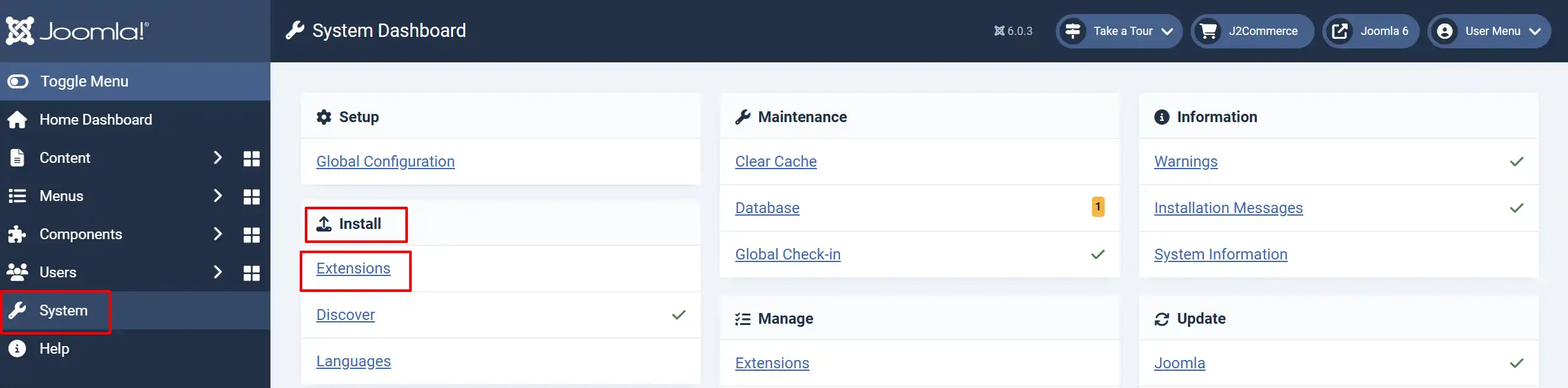
In the Joomla admin, go to System -> Install -> Extensions
Upload the plugin ZIP file or use the install from URL option.
Enable the App
NOTE: You must enable the EU VAT Plugin to automate the verification of VAT IDs against the EU database. Without this, you cannot reliably distinguish between B2B and B2C transactions.
Once you have installed the extension, you will need to enable it. There are two ways you can access the Apps.
Option A: Go to the J2Commerce icon at the top right corner -> Apps
Option B: Go to Components on the left sidebar -> J2Commerce -> Apps
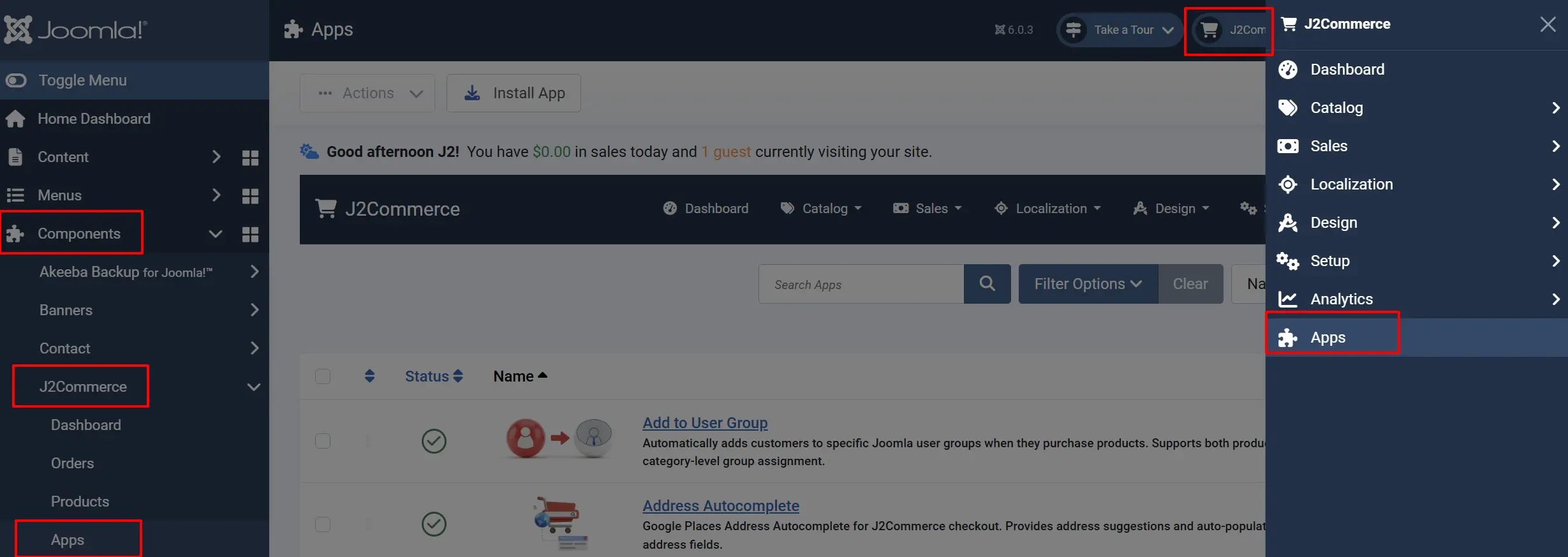
Look for European VAT click the X, and it will turn into a green checkmark. It is now enabled and ready for setup.
Store Configuration
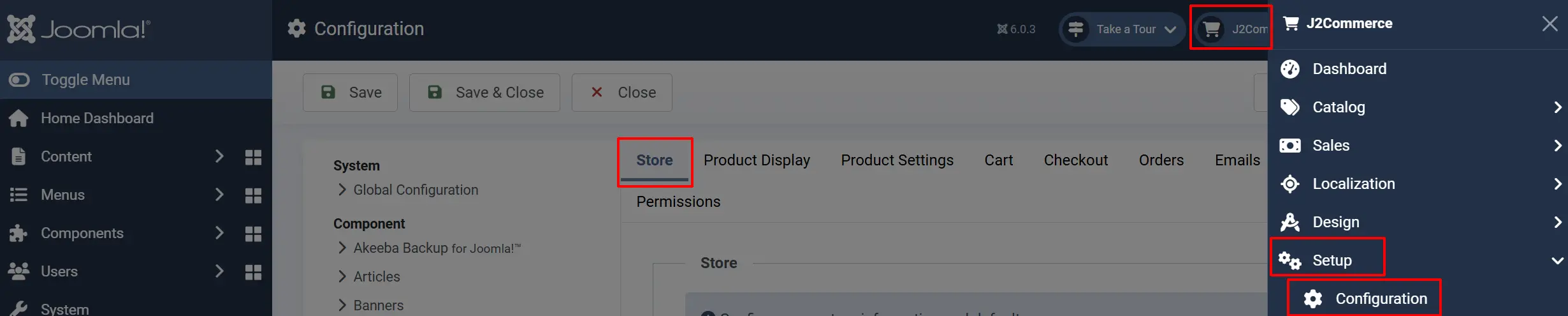
Go to J2Commerce -> Setup -> Configuration -> Store tab.
Set the Default Country to your home country. ie; United Kingdom
Set the State/Province
Create a Geozone for Europe
Create a geozone that covers Europe (or your specific province).
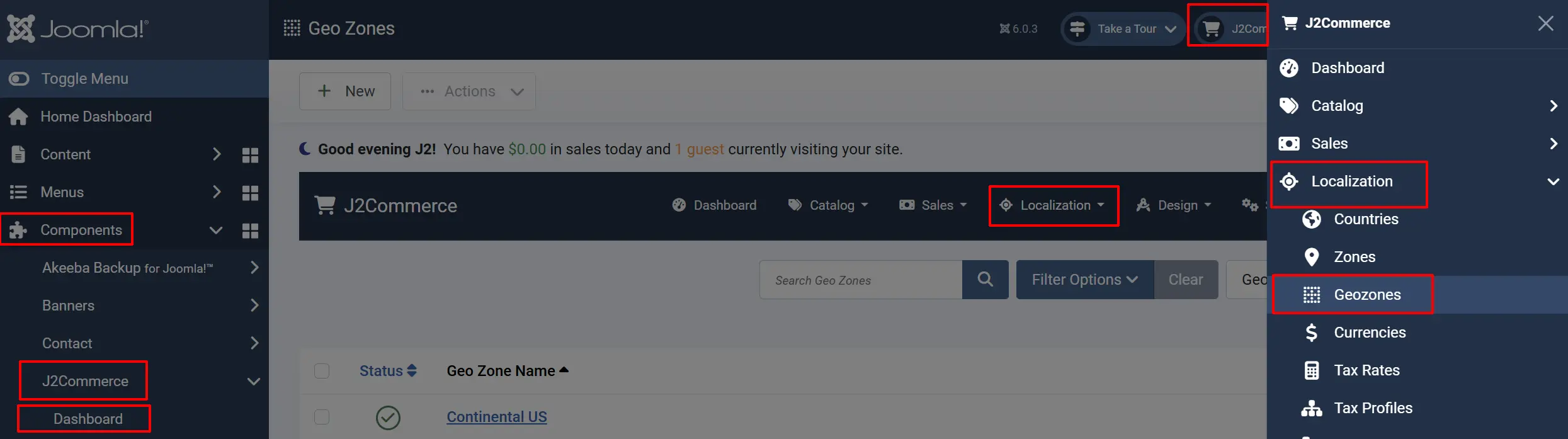
There are two ways you can access the Geozones.
Option A: Go to the J2Commerce icon at the top right corner -> Localization -> Geozones
Option B: Go to Components on the left sidebar -> J2Commerce -> Dashboard -> Localization -> Geozones
-
Click New to create a new geozone.
-
Geo Zone Name: Home VAT Zone ( It can be anything. It is used just as a reference )
-
Status: Published
-
Add country / Zone
-
Choose the United Kingdom from the Dropdown list and add it
-
Save and close
Unlike physical goods, you must create rates for the different VAT percentages across the EU:
Create a Tax Rate for Europe
Go to J2Commerce > Localization > Tax Rates > New
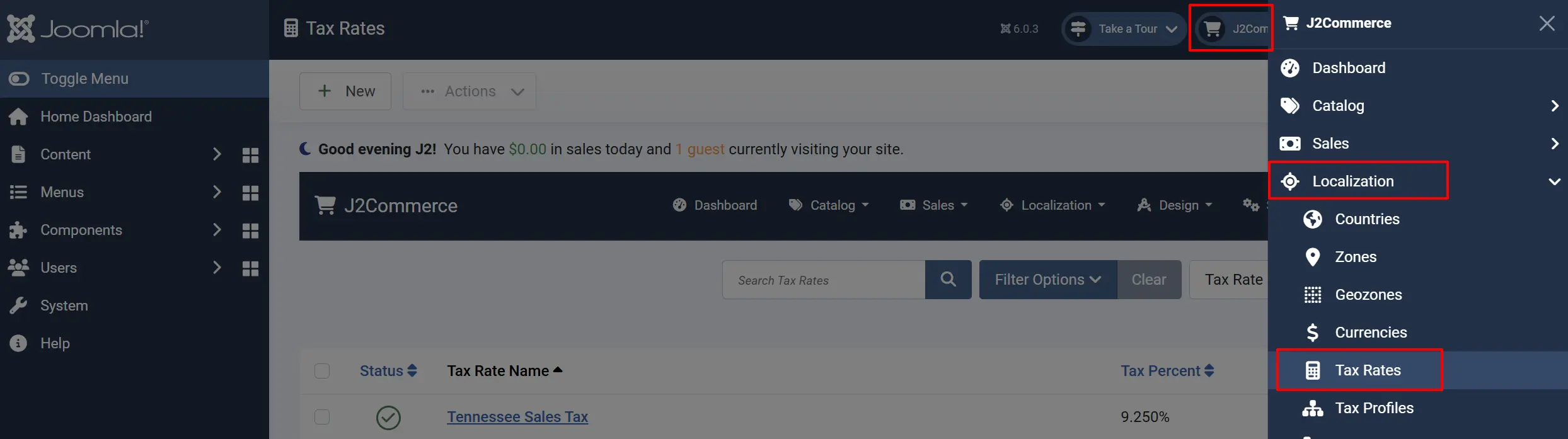
Name: Home VAT Rate
Tax Percent: 20
Geo Zone: Home VAT Zone
Status: Published
Tax rule for an EU Country. Let us take the United Kingdom as an example. Let us say, Germany’s VAT charge is: 20 %
A few countries might have the same VAT rate for digital goods. You can group them under one geo zone.
Create Geo Zones for other EU countries (or groups of countries with the same rate, e.g., "EU 20% Zone") -> Create the corresponding Tax Rates.
Set Up the Digital Tax Profile
- Go to J2Commerce -> Localisation -> Tax Profiles -> New.
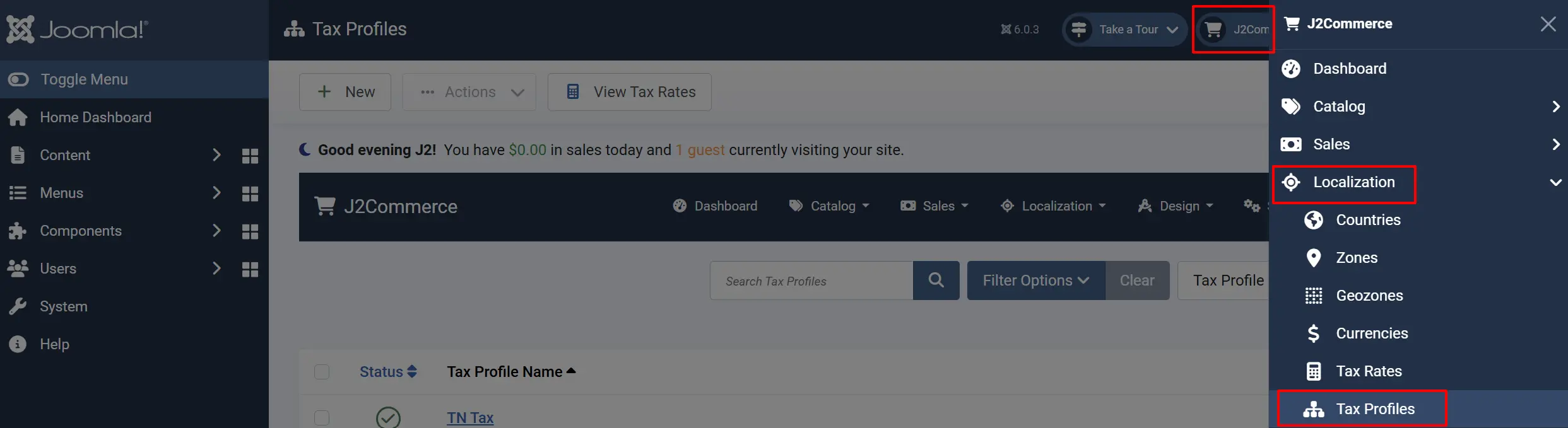
- Tax Profile Name:
Digital Goods Tax Profile. - Tax Rules: Add all the various EU VAT rates you created.
- Address Type: Set this to Billing Address (as digital goods are delivered to the buyer's legal residence).
Apply Tax Profile to Products
Each product must have the tax profile assigned.
- Go to Content -> Articles and open a product article.
- Click the J2Commerce tab.
- Go to the General tab.
- Find the Tax Profile field and select "
Digital Goods Tax Profile". - Click Save.
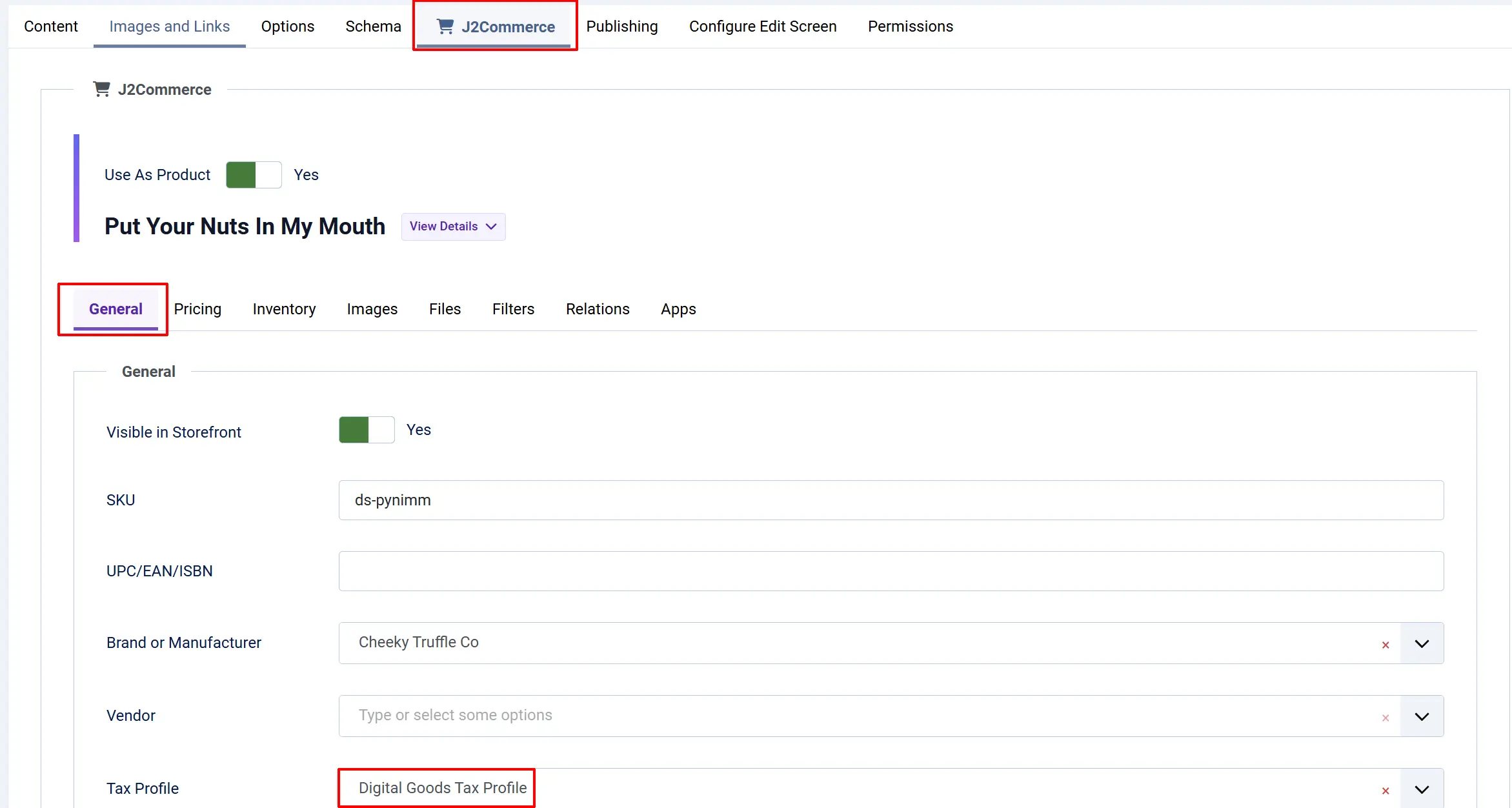
If you do not choose the tax profile, tax will NOT be applied in the storefront.
Summary of Logic
| Buyer Location | VAT ID Status | VAT Applied |
|---|---|---|
| Seller's Country | Any | Seller's Local Rate |
| Other EU Country | Valid | 0% (Exempt) |
| Other EU Country | Invalid/None | Buyer's Local Rate |
| Outside EU | Any | 0% (Exempt) |
Tips
- Create geozone groups for countries with the same VAT rate to reduce configuration work
- Test with addresses from different EU countries to verify that the correct VAT rates apply
- The EU VAT plugin validates VAT numbers against the official VIES database in real-time
Troubleshooting
Wrong VAT rate for digital products
Cause: The geozone for a specific country has the wrong rate or is missing.
Solution: Create a geozone for each unique VAT rate group (e.g., "EU 20% Zone" for countries with 20% VAT) and add the corresponding tax rate.
VAT not applied to EU customers
Cause: The product does not have a tax profile assigned.
Solution: Edit the product article, go to the J2Commerce tab, and select the "Digital Goods Tax Profile."
0% VAT showing for B2C customers
Cause: The VAT validation plugin may be treating all customers as businesses.
Solution: Verify the customer is not entering a VAT number. If they are, the plugin will validate it. Ensure the checkout process clearly separates B2C (individuals) from B2B (companies with VAT IDs).