Safepay Payment
The Safepay Payment plugin lets your J2Commerce store accept Visa and Mastercard payments through your Safepay (getsafepay) account. Safepay is a Pakistan-based gateway that charges in Pakistani Rupees (PKR) by default and also supports other currencies such as USD, GBP, and EUR.
Customers can pay using card fields shown right on your checkout page (Embedded mode) or on a secure Safepay-hosted page (Hosted mode). Returning shoppers can also save a card for faster checkout next time.
Requirements
- PHP 8.3.0 +
- Joomla! 6.x
- J2Commerce 6.x
- An active Safepay merchant account at getsafepay.com
Get Your Safepay Keys
Before you configure the plugin, copy these three keys from your Safepay dashboard (Developers section):
| Key | Where it goes | Notes |
|---|---|---|
| Merchant API Key (Public) | The Merchant API Key field | Public key, usually starts with sec_. |
| Secret Key | The Secret Key field | Private key — keep it confidential. |
| Webhook Secret | The Webhook Secret field | Found under Developers -> Endpoints -> View shared secret. |
NOTE: Safepay gives you a separate set of keys for sandbox (testing) and live (production). Sandbox and live keys are not interchangeable. Use sandbox keys while testing, then switch to live keys when you go live.
Purchase and download
This plugin is a separate add-on available from the J2Commerce Extensions Store. It is not included with the core J2Commerce 6 component.
- Go to the J2Commerce website and locate SafePay.
- Add it to your cart and complete checkout.
- Go to My Downloads under your account profile and find the plugin.
- Click Available Versions -> View Files -> Download Now to download the ZIP file.
Install the plugin
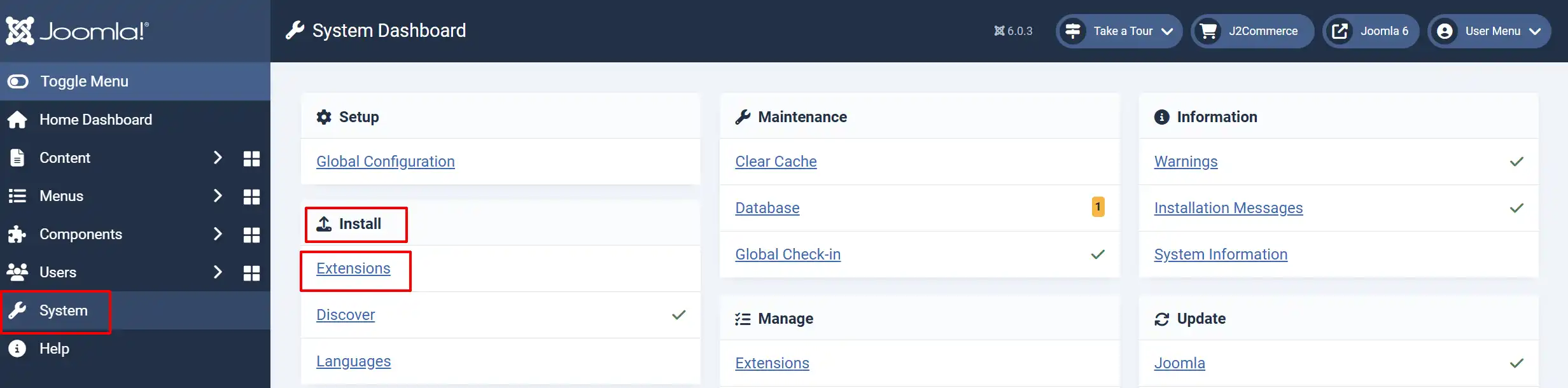
In the Joomla Administrator, go to System -> Install -> Extensions.
Upload the plg_j2commerce_payment_safepay.zip file.
Enable the Plugin
Once you have installed the App, you will need to enable it. There are two ways you can access the App.
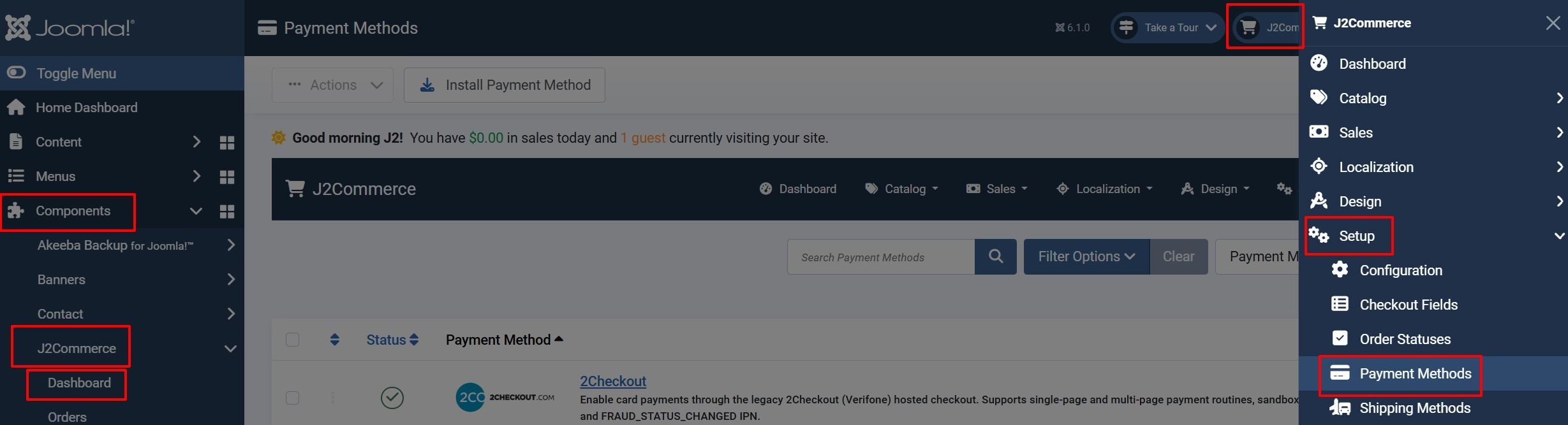
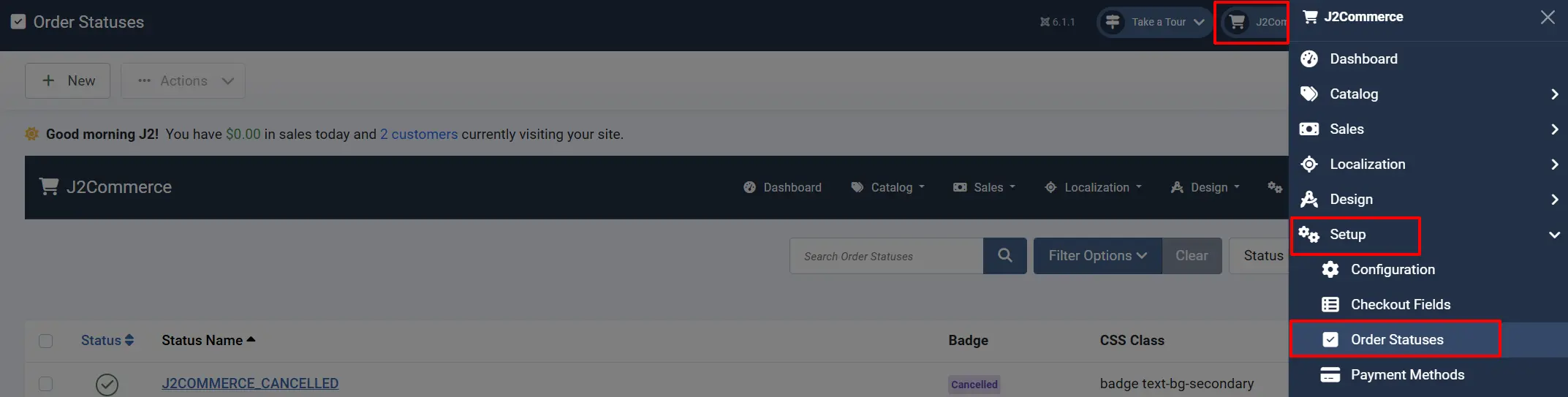
Option A: Go to the J2Commerce icon at the top right corner -> Setup -> Payment Methods
Option B: Go to Components on the left sidebar -> J2Commerce -> Dashboard -> Setup -> Payment Methods
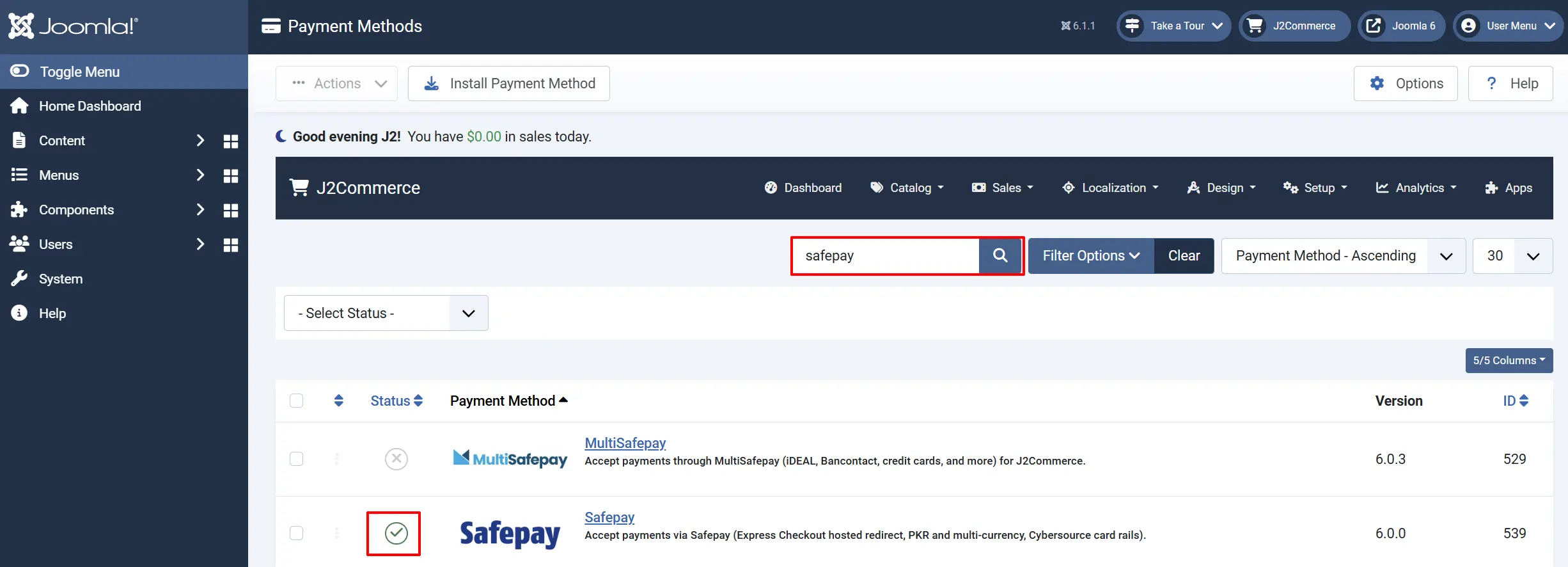
To help you narrow down the list, you can do a search for SafePay, click the X, and it will turn into a green checkmark. It is now enabled and ready for setup.
Configure the plugin
Click the SafePay title next to the green checkmark to open the configuration screen.
Click the Toggle Inline Help button at the top of any plugin configuration page to show a short description beneath each field.

Display Settings
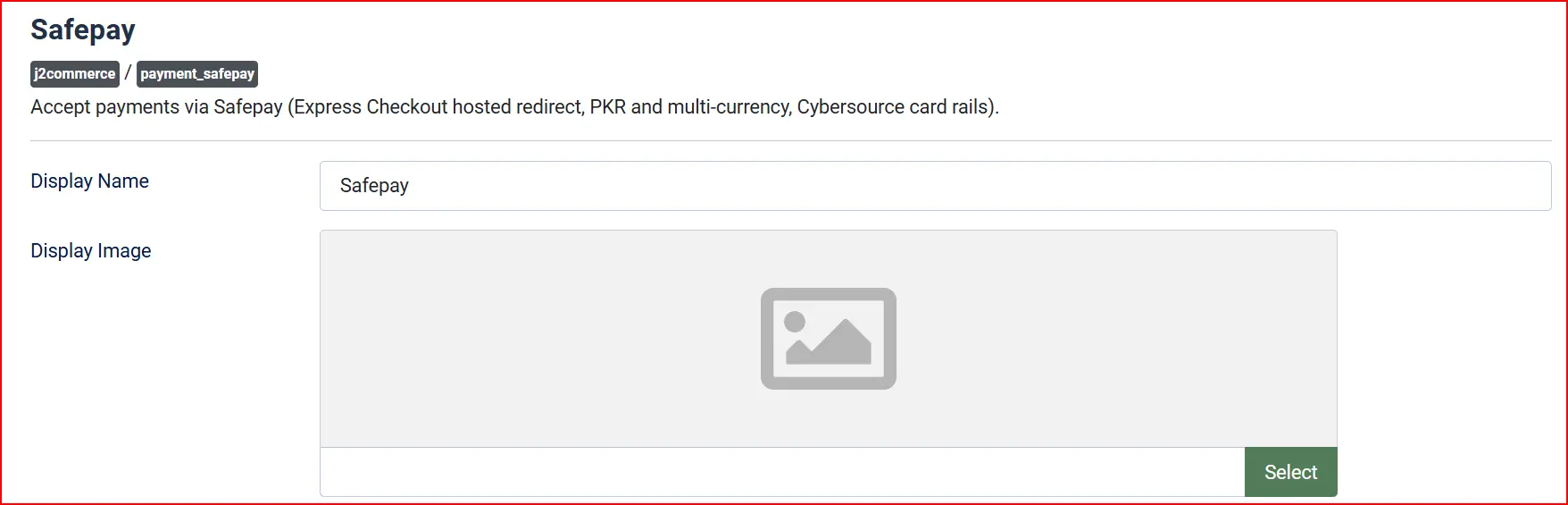
Display Name: The name customers see at checkout. Default is Safepay.
Display Image: An optional logo or card-brand image shown next to the payment option.
API Credentials

Sandbox Mode: Set to Yes to test with sandbox keys and the Safepay test environment. Set to No for real, live payments.
Merchant API Key (Public): Your public merchant API key (live). Shown when Sandbox Mode is No.
Secret Key: Your private secret key (live). Shown when Sandbox Mode is No.
Webhook Secret: The webhook signing secret (live). Shown when Sandbox Mode is No.
Sandbox Merchant API Key / Secret Key / Webhook Secret: The same three keys, but for the sandbox environment. Shown when Sandbox Mode is Yes.
NOTE: The plugin automatically shows the correct set of key fields based on your Sandbox Mode choice, so you only ever fill in the keys you need.
Webhook URL

The Webhook URL field shows a unique address that lets Safepay notify your store when a payment succeeds, fails, or is refunded. This keeps your orders up to date even if a customer closes their browser mid-payment.
- Copy the URL shown in the Webhook URL field.
- In your Safepay dashboard, go to Developers -> Endpoints and add it as a new endpoint.
- Subscribe to the payment and subscription events.
Always keep webhooks set up. Without them, an order may not be marked as paid if the customer's connection drops after payment.
Checkout Options
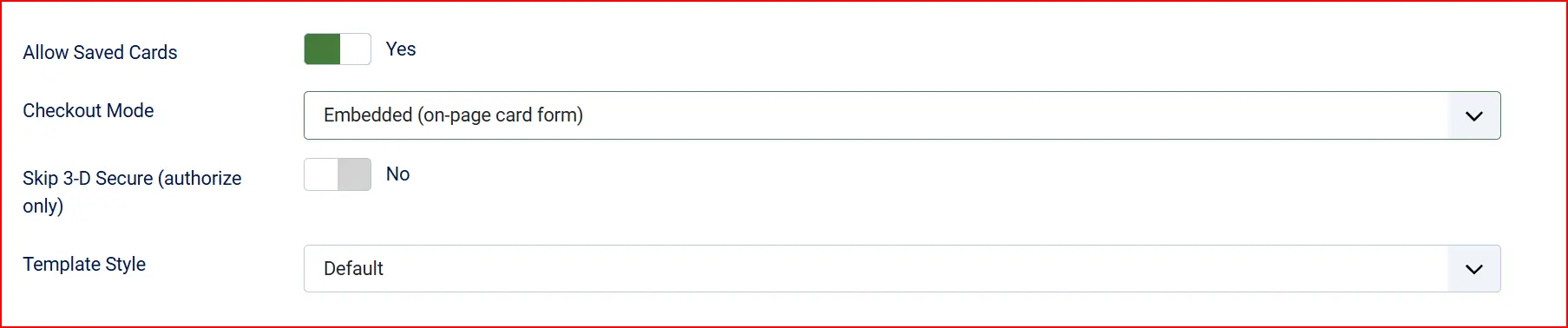
Allow Saved Cards: Set to Yes to let returning customers pay with a card they saved on a previous order.
Checkout Mode: Embedded shows Safepay card fields directly on your checkout page (recommended). Hosted sends the customer to a Safepay-hosted payment page, then back to your store.
Skip 3-D Secure (authorize only): Embedded mode only. Leave this No for production. Only set to Yes if your Safepay account is not set up for 3-D Secure, or for low-risk testing.
Template Style: Choose a layout override if you have a custom checkout template. Leave as default for the standard look.
NOTE: 3-D Secure is the extra verification step (such as a one-time code from the bank) that protects against fraud. Keeping it on is strongly recommended for live stores.
Order Status
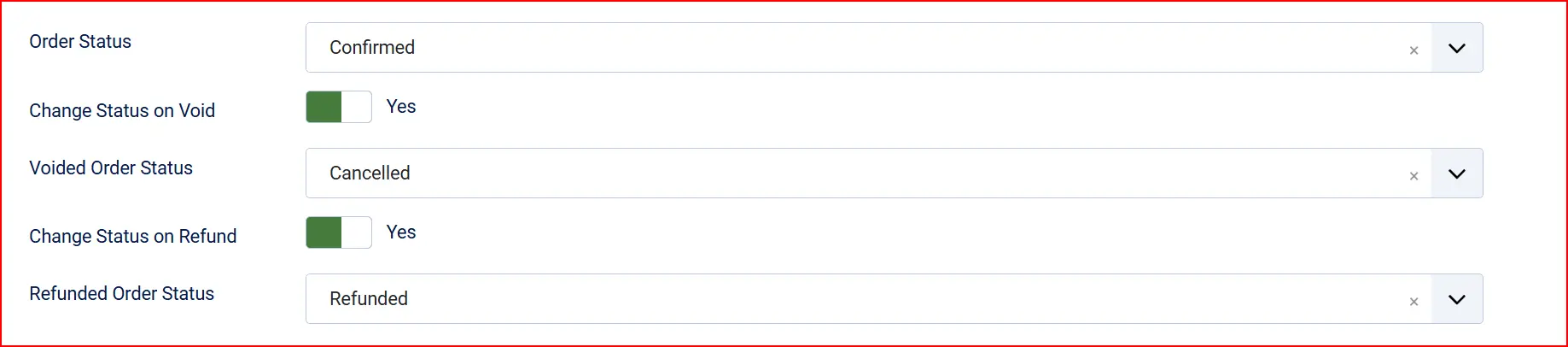
Order Status: The status an order is set to after a successful payment (for example, Confirmed).
Change Status on Void: Set to Yes to automatically change the order status when a payment is voided.
- Void Order Status: The status to apply when an order is voided. Shown when Change Status on Void is Yes.
Change Status on Refund: Set to Yes to automatically change the order status when a payment is refunded.
- Refund Order Status: The status to apply when an order is refunded. Shown when Change Status on Refund is Yes.
If the order status you want is not listed, create it first under J2Commerce -> Setup -> Order Statuses.
Surcharge (Optional)

Use these fields if you want to add a small handling fee when a customer pays with Safepay.
Surcharge Name: The label shown for the fee on the order (for example, Card processing fee).
Surcharge Percent: A percentage of the order total to add as a fee.
Surcharge Fixed: A fixed amount to add as a fee.
Surcharge Tax Class: The tax profile to apply to the surcharge, if it should be taxed.
Restrictions (Optional)

Geo Zone Restriction: Limit Safepay to customers in a specific geographic zone. Leave empty to allow everyone.
Minimum Subtotal: Hide Safepay unless the cart total is at least this amount. Leave empty for no minimum.
Maximum Subtotal: Hide Safepay when the cart total is above this amount. Leave empty for no maximum.
Custom Checkout Messages
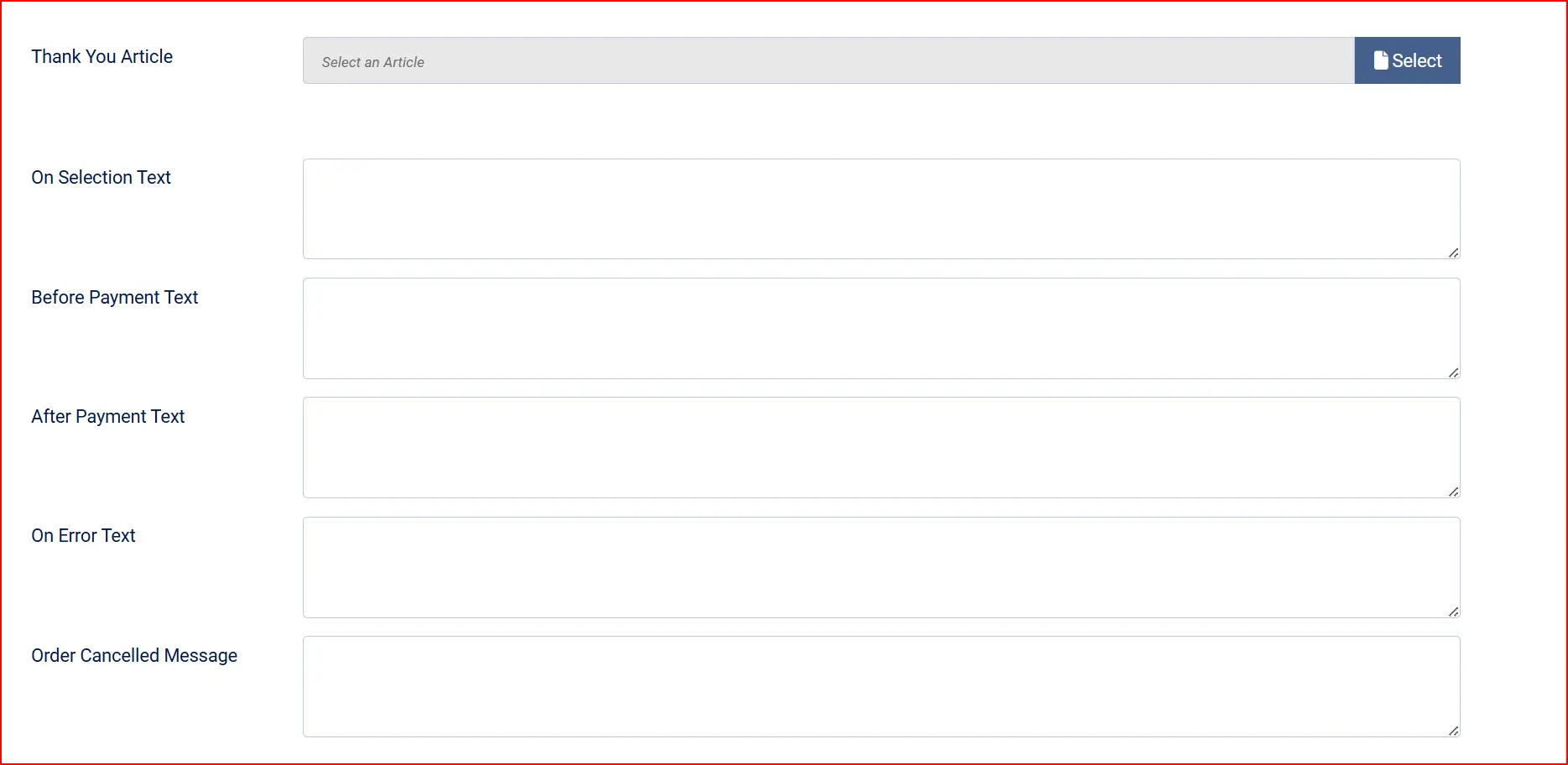
These optional text fields let you customise what customers see at each stage of the payment flow.
Thank-You Article: Optional Joomla article to display after a successful payment
On Before Payment: Text shown before the customer is redirected to Barclaycard
On After Payment: Text shown on the order confirmation page after a successful payment
On Error: Text shown when a payment error occurs
On Cancel: Text shown when the customer cancels on the Barclaycard page
Extras (Optional)

Show Dashboard Icon: Set to Yes to add a quick-access icon for Safepay on the J2Commerce dashboard.
- Icon Label: The text shown under the dashboard icon. Shown when Show Dashboard Icon is Yes.
Debug Logging: Set to Yes to record all Safepay requests and responses to a log file. Use only while troubleshooting, then turn it off.
How It Works
When a customer reaches checkout and chooses Safepay:
- The customer selects Safepay as the payment method.
- In Embedded mode, they enter their card details right on your checkout page. In Hosted mode, they are taken to the secure Safepay payment page.
- Safepay runs 3-D Secure verification with the customer's bank (when enabled).
- After payment, the customer returns to your store and sees the order confirmation.
- Safepay also sends a webhook to your store to confirm the result, so the order is marked paid even if the customer's connection drops.
Managing Payments from the Order
Once an order has been paid through Safepay, you can manage it from the order view in J2Commerce -> Sales -> Orders. Depending on the payment's stage, you may see buttons to:
- Capture — collect a payment that was only authorized.
- Void — cancel a payment before it settles (typically within 24 hours).
- Refund — return money to the customer after settlement (full or partial).
- Charge Saved Card — bill a card the customer saved previously.
NOTE: The available actions depend on how far along the payment is. For example, a settled payment can be refunded but not voided.
Tips
- Test in sandbox first — Turn on Sandbox Mode, enter your sandbox keys, and place a test order before going live.
- Always set up the webhook — It keeps orders accurate even if a customer closes their browser during payment.
- Keep 3-D Secure on — It protects you against fraud and chargebacks on live stores.
- Turn off Debug Logging after troubleshooting to keep your log files small.
- Use the right currency — Safepay is PKR-first; make sure your store currency is one Safepay supports.
Troubleshooting
Safepay Does Not Appear at Checkout
Cause: The plugin is disabled, or an availability rule is hiding it.
Solution:
- Go to J2Commerce -> Setup -> Payment Methods and confirm Safepay shows a green checkmark.
- Open the Safepay settings and check Minimum Subtotal, Maximum Subtotal, and Geo Zone Restriction — the cart may fall outside these limits.
- Confirm the customer's location matches any geo zone you set.
Payment Fails or Is Declined
Cause: Incorrect API keys, or sandbox keys used on a live store (or the reverse).
Solution:
- Open the Safepay settings and check Sandbox Mode is set correctly (Yes for testing, No for live).
- Re-copy the Merchant API Key, Secret Key, and Webhook Secret from your Safepay dashboard for the matching environment.
- Save and place a new test order.
Order Stays Pending After a Successful Payment
Cause: The webhook is not set up, so Safepay cannot notify your store.
Solution:
- Open the Safepay settings and copy the Webhook URL.
- In your Safepay dashboard, go to Developers -> Endpoints and add it as an endpoint.
- Subscribe to the payment events and make sure the Webhook Secret in the plugin matches the one in your dashboard.
Cannot Save or Reuse a Card
Cause: Allow Saved Cards is turned off.
Solution:
- Open the Safepay settings.
- Set Allow Saved Cards to Yes and click Save.
Need More Detail to Diagnose a Problem
Cause: You need to see what Safepay is returning.
Solution:
- Open the Safepay settings and set Debug Logging to Yes.
- Reproduce the problem with a test order.
- Check the
payment_safepay.phplog file under your site's log folder. - Turn Debug Logging back to No when you are finished.